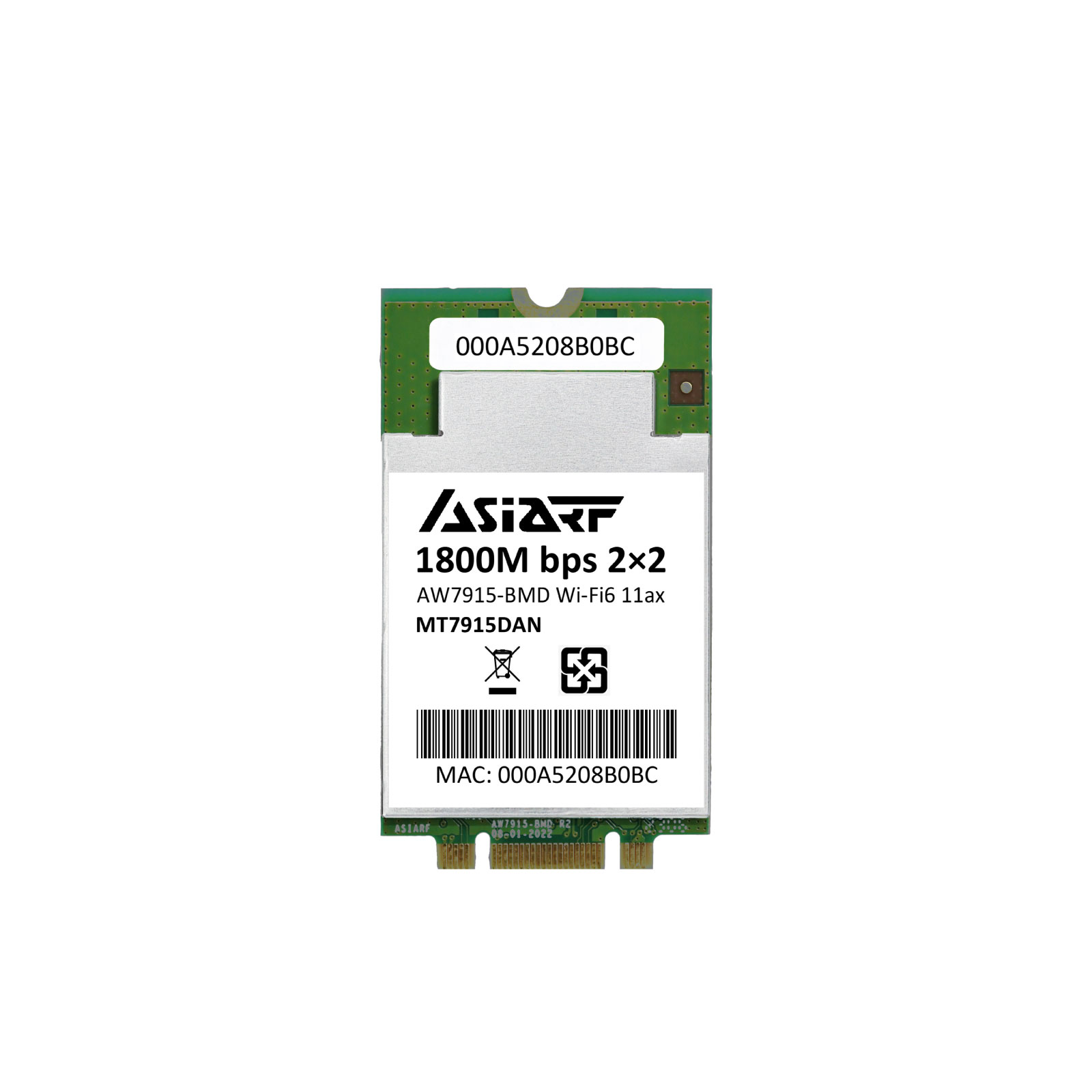
Description AW7915-BMD: Reliable Wi-Fi 6 M.2 BM Key Module with 1800Mbps PHY Rate – 2T2R Dual Bands Dual Concurrents DBDC IEEE802.11ax by Mediatek MT7915DAN Introducing the AW7915-BMD, a Wi-Fi 6 M.2 Module with BM Key, powered by the MT7915DAN chipset. It’s your ticket to rock-solid wireless connectivity with a speedy PHY rate of 1800Mbps. And guess what? It plays nicely with a bunch of IEEE standards, including 802.11ax/ac and even the older 802.11 ac/a/b/g/n ones. Now, let’s talk tech. This module is no slouch. It’s got some clever tricks up its sleeve. Thanks to its optimized RF architecture and smart MAC design, it performs like a champ while sipping power conservatively. Plus, it’s all about dual bands and dual concurrent operation, which means it can juggle two wireless tasks at once. When it’s time for a power nap, it’s got you covered too. It has multiple power domains and can go into a deep sleep mode to save those precious watts. Inside, you’ll find a 32-bit RISC MCU subsystem, clock control options, and PDMA engines to keep your data flowing efficiently. But here’s where it really shines. The MT7915DAN chipset inside combines the Wi-Fi MAC and BBP subsystems to deliver top-notch radio performance. It’s all about giving you the best possible connection. It even supports multi-user MIMO (MU-MIMO) for when you’ve got a crowd of devices. And don’t worry about your data’s speed – it’s got an integrated PCIe interface for a stable, high-speed link between your device and the module. In a nutshell, the AW7915-BMD is a high-performance Wi-Fi 6 module that’s all about advanced features, efficient power use, and keeping you connected to multiple devices. Key capabilities and benefits The operation of Wi-Fi 6E in the 6 GHz spectrum offers extremely wide 160 MHz channels and additional capacity, leading to enhanced network performance. Orthogonal frequency division multiple access (OFDMA) more efficiently allocates channels, thereby increasing network efficiency and reducing latency for both uplink and downlink traffic in high-demand environments. Multi-user multiple input, multiple output (MU-MIMO) allows more uplink and downlink data to be transferred at once and enables an access point to handle a larger number of concurrent clients. The ability to utilize a 160 MHz channel increases bandwidth, resulting in enhanced performance with minimal latency. 1024 quadrature amplitude modulation mode (1024-QAM) enables throughput increases by encoding more data in the same amount of spectrum. Transmit beamforming enhances signal power, leading to significantly higher data rates within a specified range. Wi-Fi generation comparison overview Feature Wi-Fi 4 Wi-Fi 5 Wi-Fi 6 Channel bandwidth (MHz) 20, 40 20, 40, 80, 80 80, 160 20, 40, 80, 80 80, 160 Frequency bands 2.4 and 5 GHz 5 GHz 2.4,5, and 6 GHz Maximum data rate 150 Mbps 3.5 Gbps* 9.6 Gbps* Highest subcarrier modulation 64-QAM 256-QAM 1024-QAM Spatial streams 1 4 8 Underlying technology IEEE 802.11n IEEE 802.11ac IEEE 802.11ax * Depending upon number of spatial streams and channel used Specification Comparison Chart : Best-Selling Wi-Fi ModuleLearn more on our blog: How to choose good performance Wi-Fi module for Robot?Or follow us on Linkedin : Why use Wi-Fi 6E? What are the benefits of Wi-Fi 6E products?